Sweet

Image
special introductory paragraph

First Recordings 1968-1971

Funny How Sweet Co-Co Can Be

Live at the Rainbow 1973

Sweet Fanny Adams

Desolation Boulevard (British version)

Strung Up

Give Us a Wink!

Live in Denmark

Off the Record

Level Headed

Cut Above the Rest

Water’s Edge

Identity Crisis

The Sweet (a.k.a. Sweet) – lead singer Brian Connolly, guitarist/keyboardist/singer Andy Scott, bassist/singer Steve Priest and drummer Mick Tucker – are mostly known (at least in the States anyway) as the above pictured, cute looking glam rock band with the catchy original and Mike Chapman/Nicky Chinn penned hits like “Ballroom Blitz”, “Wig Wam Bam” and “Hell Raiser.”  And, by the time they did “Love Is Like Oxygen”, they didn’t even wear makeup anymore!  But, even if that wasn’t the case, the glam tag is only a very small part of the picture.  In fact, to even call the Sweet a glam rock band is about as accurate as saying that “You Really Got Me” and “All Day and All of the Night” are entirely representative of the Kinks’ discography.  It’s a bloody lie is what it is!  Perpetrated on the notion that after a few TV appearances, the Sweet liked being a gittery teeny bopper band when, in actuality, they would have preferred to have rocked in front of denim clad Black Sabbath and Deep Purple fans.  But that’s the brush you paint yourself with when, out of desperation, you record songs like “Little Willy” and “Wig Wam Bam” (which I like a lot, mind you).  And that’s why I’m here to blow the lid off their operation so read on, will you?

Also, prior to Sweet, Mick Tucker played in Wainwright’s Gentlemen with Ian Gillan of Deep Purple.  Ain’t that a hoot?

First Recordings 1968-1971 – Repertoire – 1991

Image

The Sweet formed in 1968 under their original name the Sweetshop but another group had that name so they chopped the “shop.”  The group already consisted of singer Brian Connolly, bassist Steve Priest and drummer Mick Tucker but Andy Scott wouldn’t complete the classic lineup until 1970.  The original guitarist was some guy named Frank Torpey and he was replaced by another guy named Mick Stewart.  Before they started getting successful with those cutesy Mike Chapman/Nicky Chin penned hits, the Sweet released four unsuccessful singles (the first with Torpey and the other three with Stewart) all of whose a and b sides were compiled onto First Recordings 1968 – 1971 along with four previously unreleased tracks.

So what kind of music were the Sweet making in their first couple years of existence?  Basically they were a typical mid/late 60s rock/pop band who played in a variety of sub-genres including light weight mid 60s rock, quirky psychedelic pop, folky rock, Steppenwolf style funky rock, bluesy rock and soul but absolutely no bubblegum.  However don’t think the band were using too much Hendrix/Townsend-esque feedback as these songs tend to lean towards the lighter side of 60s rock.  The obvious exceptions are the fuzz rockers “The Spider” and “My Little Girl from Kentucky.”  Most of the melodies and arrangements are nice (especially memorable opening track “The Lollipop Man”) , with the sound filled out with keyboards, piano or horns and the songs evoke whatever emotions they’re supposed to (happy, pensive) but there is nothing distinctly *Sweet* about them.

Brian Connolly has yet to adapt that high pitch yelling voice.  Instead he sounds like a normal British singer, hitting the notes just fine but not doing anything that sets him apart from the rest.  Neither original guitarist Frank Torpey nor his replacement Mick Stewart are particularly remarkable players either though I like the psychedelic solos on “It’s Lonely Out There.”  Likewise neither Steve Priest nor Mick Tucker are doing anything that interesting with their respective instruments aside from providing a solid rhythm section.

In conclusion this early version of Sweet was another typical mid/late 60s band; cutting singles, playing the club circuit and trying to make it but, like most of them, the best they had to offer at this time was a collection of neat, little tunes that otherwise didn’t really stand out from the competition and nowadays serve more as a fun relic from the era.

Funny How Sweet Co-Co Can Be – RCA – 1971
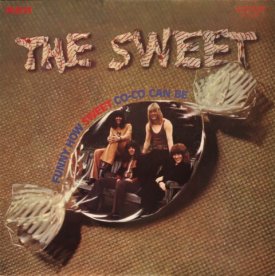
Image

The true saga of Sweet began in 1970.  Guitarist/keyboardist Andy Scott joined the band to complete their classic lineup and the group hooked up with producer Phil Wainmen and the songwriting duo of Mike Chapman and Nicky Chinn, who wrote a bunch of songs for the Sweet in order to keep their career afloat.  Members of the band did write their own material but the label didn’t allow that material to be the main showcase of the group’s talent.  The result of the Chapman/Chinn pairing up with the group is a whole bunch of catchy, cutesy little singles and this here album called Funny How Sweet Co-Co Can Be.

What’s most fascinating to me about the first Sweet LP is how incongruous it was with what was going on with rock and pop at the time.  The album may have come out in 1971 but it sounds like the type of thing that would have been released in 1966.  The label hired a group of kids who might or might not have actually played on every track of their album while outside writers supplied a bunch of material in various sub-genres of rock and pop and marketed it to the little kiddies as “bubblegum.”  However there is only really one true “bubblegum” song on the album; the Archies flavored “Funny Funny.”

The rest of the album is a mish-mash of styles that shows that neither Mike Chapman/Nicky Chinn nor the Sweet had much of an idea of what kind band they were trying to be.  With that said, it’s for the most part a highly listenable, catchy and fun album.  Brian Connolly hasn’t began using his awesome, high pitch shouting that makes up the bulk of the classic Sweet material and helps give it so much personality.  Instead he uses a calm, pleasant, normalish British singing voice that occasionally sounds like Marc Bolan, which I will discuss in further detail momentarily.  Andy Scott’s guitar playing has none of the distorted fire power or killer chops it would have as early as their second album, instead playing it quiet and normal with little or no distortion, throwing in the occasional steel guitar slide, save for album closer and obvious exception “Done Me Wrong All Right.”  Steve Priest and Mick Tucker are just a solid human metronome.  And I believe Brian Connolly is the only member on “Co-Co” and “Funny Funny” with the instruments being played by session musicians.

The song count goes as follows:

Four Sweet penned (and played!) originals:
“Honeysuckle Love” – dead ringer for T. Rex right down to the singing and the basic “bap-bap”, “Bang a Gong” style chord progression, really good!
“Jeannie” – acoustic, jangly folk rock like something the Beatles or the Kinks did or, I dunno, like “Mrs. Robinson” complete with “la-la-la” backing vocals, pretty good regardless
“Spotlight” – solid attempt at mysterious sounding, 1966 era psychedelia complete with duel track acoustic/electric guitars and multi-part “ah-ah-ah” harmonies.
“Done Me Wrong All Right” – hard rock!!!  Straight forward, to the bone, hard rock and the only song that gives any indication of Sweet’s future direction.  I take back what I said about it being different from other songs on the album because according to wiki, it wasn’t even on the album!

Six Mike Chapman/Nicky Chinn compositions:
“Co-Co” – aside from the guilty pleasure, stupid/catchy chorus of “Ho-chi-ka-ka-ho Co-Co”, could pass for acoustic T. Rex minus the island rhythm and steal drums
“Chop Chop” – okayish T. Rex/Beatles pop song, nuttin’ essential but has a cute chorus that goes, “timber”
“Santa Monica Sunshine” – countryish rock, catchy chorus
“Funny Funny” – aforementioned, Archies-inspired bubblegum.
“Tom Tom Turnaround” – very pretty countryish, folk ballad
“Sonny Sleeps Late” – folky, pop rock, complete with “Get Back” style galloping percussion and twangy, country-ish guitar

Two covers”
“Reflections” – Supremes cover, sounds pretty good for a soul song covered by a white, British singer
“Daydream” – Lovin’ Spoonful cover, mid-60s, pre-hippy, happy-go-lucky, Sesame Street music played on acoustic guitar

See what I mean?  Lotsa diversity but no real focus.  That’s no way to carry a career.  It’s impressive that they could handle so many styles so well but still, ya know.

Sweet Fanny Adams – RCA – 1974
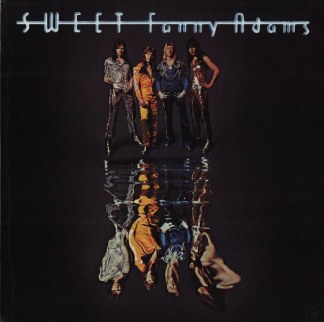
Image

Although the group’s leap from their first to second album is pretty huge, it isn’t fair to call it an abrupt change considering that the album was released three years after the first and that the group had enough time to cultivate their hard rock/heavy metal sound; after all the glammy, foot stomping, hand clapping, Chapman/Chinn penned, Marc Bolan/David Bowie style singles they released during that time (“Ballroom Blitz”, “Hellraiser”, “Blockbuster” and “Teenage Rampage”) are all backed by tighter, harder, more musically complex tunes that the band wrote themselves.

As alluded above, on Sweet Fanny Adams, Sweet have all but entirely turned into a mean ass, hard rock/heavy metal band. Andy Scott’s guitar is super loud, bright and distorted, Brian Connolly is now shouting the lyrics rather than singing, Mick Tucker’s drumming is ferocious in a vein similar to someone like Ian Paice and the group is putting those multi-part, high pitch vocal harmonies (“ahh-ahh-ahh”) to good use. Also both Andy Scott and Steve Priest sing a good deal on the album possibly due to Connolly being in an accident which damaged his vocal chords.

The album consists of four mean hard rock songs that might evoke comparisons to Queen and Deep Purple, two punky glam rock stompers that sound like they should have been released as singles rather than on the album, a fun but pointless cover of “Peppermint Twist” and two rip-roaring metal tunes that are essentially the New Wave of British Heavy Metal three or four years ahead of its time.

In fact, I feel that “Set Me Free” (later covered by Saxon) is so ahead of its time and so important to mention in light of the group’s overall body of work that I’m setting a separate paragraph aside for it! I was pretty darn surprised when I heard “Set Me Free” for the first time as I was not expecting chugga-chugga style, proto speed metal with a wicked guitar workout to have come out in 1974; especially considering that, at that time, Judas Priest, the band known to have invented that approach, was still just another blues based heavy rock band.

The rest of the album isn’t nearly as metal but still totally great and the angry, galloping, electric/acoustic double tracked “Sweet F.A.” has one of the most questionable lines you’d hear uttered by a group allegedly marketed to teeny boppers; oh what the hell am I talking about? They were already performing the tacky, sexist “Someone Else Will” so I shouldn’t be shocked by a line that goes “if she don’t spread/I’m gonna bust her head.” What’s strange though is that I would have assumed that the angry, melodramatic hard rocker “No You Don’t” (complete with blatant “Pinball Wizard” musical homage) was an original while the glam/punk “Rebel Rouser” (later covered by the Meatmen) is a Chapman/Chinn tune but, oddly, they are switched.  The other glam tune is the awesome Chapman/Chinn lesbian anthem “A.C.D.C.” (later covered by Joan Jett).

In short, Sweet rule.

Desolation Boulevard (British version) – RCA – 1974
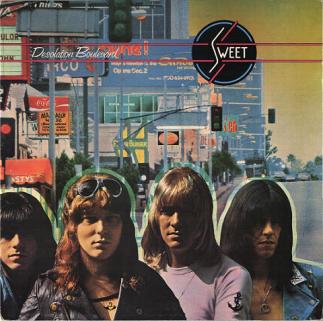
Image

If you live in North America and you found a copy of Desolation Boulevard in your mom’s record crate or in the $1 bin at your local used record shop, then you’ve been bamboozled!  Like other labels did with British bands they were trying to market to American audiences, the group’s American label assembled an album consisting of tunes from a couple albums and singles, ignoring the integrity of the group’s catalog – in this case, sampling songs the from Sweet Fanny Adams, Desolation Boulevard and the group’s various singles.  The only unique thing about it is the awesome “I Wanna Be Committed” but, since I have the CD reissue of Desolation Boulevard, that’s rendered useless as well.

The American Desolation Boulevard is the first Sweet album I heard and it turned me into a fan but that doesn’t excuse the fact that American fans missed out on songs like “Heartbreak Today”, “Rebel Rouser”, “Peppermint Twist”, “Restless”, “Turn It Down”, “Medusa”, “Man with the Golden Arm”, “Breakdown”, “My Generation” and the original, bare bones recording of “Fox on the Run.”

Desolation Boulevard, though not bad is disappointing compared to Sweet Fanny Adams. I would have preferred the group’s many fine, hard rocking originals that appeared as b-sides – such as “Own Up, Take a Look at Yourself”, “Burn on the Flame” or “Someone Else Will” – over what made the a-list. “My Generation” is great; Brian Connolly does his best stuttering Roger Daltry impression, Steve Priest nails John Entwhistles’s noodly bass parts and Mick Tucker pulls off Keith Moon’s rolls just fine but it’s still just a cover of “My Generation.” Also the cover of the theme from Frank Sinatra’s 1955 heroine vehicle Man with the Golden Arm is something you perform in concert to get the crowd pumped not subject people to in their homes no matter how good Mick Tucker’s drum solo is. And the boring ballad “Lady Starlight” can take a hike as well.

On the other hand, Desolation Boulevard is almost entirely devoted to hard rock of various tones and moods, containing nothing as metallic as “Set Me Free” nor as sugary as “Peppermint Twist.”  The band does some great stuff with arrangement and electric/acoustic double tracking in “The Six Teens” and “Medusa” and tear it up on songs like “Solid Gold Brass” and “Breakdown.” Also it’s interesting to note how it’s becoming more difficult to tell a Chapman/Chinn tune from an original. For instance the Chapman/Chinn penned “Turn It Down” and the original “Fox on the Run”(the original album version doesn’t include the bubbling, space synthesizer or the “ah-ah-ah” backing vocals) both are better interpretations of the basic, big-Major-chord-plus-anthemic-sing-along-chorus approach of Kiss or Slade. Did I also mention that Brian Connolly has a really great, tough but melodic singing voice?

In 1975 the Sweet decided to give it a go on their own, ditching Mike Chapman and Nicky Chinn and deciding to write their own material like 99.999% of their contemporaries.

Give Us a Wink! – Polydor – 1976
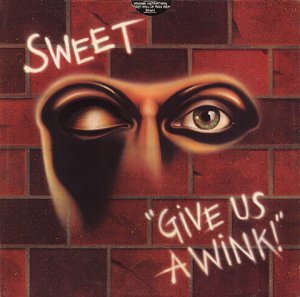
Image

As I just said a moment ago, in 1975, the Sweet told Mike Chapman and Nicky Chinn that they were going to write and produce their own albums.  And this was the failing result—

Give Us a Wink! is a fanstaic album, more consistently pleasing than Desolation Boulevard and a perfect example of why one shouldn’t judge a book by its cover!   With a title like Give Us a Wink!, a cover like the one pictured above and a bunch of corny graffiti which reads stuff like “wink off” sprinkled on the back, one who was only familiar with Sweet’s glam singles might be inclined to believe the album is even more of that kinda stuff.

But that would be a incorrect!  Instead the Sweet have recorded an album of hard rock/heavy metal tunes that once again might evoke thoughts Deep Purple or Led Zeppelin crossed with maybe a little bit of Queen-esque, high pitch backup vocals and synthesizer riffs.  And again it should be noted that Andy Scott has a loud, heavy, crunchy and reverbed guitar tone that really brings out those riffs.  I neglect to think why, say, Deep Purple’s “Burn” couldn’t have been produced with the same gusto.

Although I like the opening track “The Lies in Your Eyes”, it might come off as a novelty song to some due to its blatant musical homages to “Baba O’Riley” and “Satisfaction” but, then on in, the next seven songs are killers.  Okay also closing song “Healer” has a weird, funky groove that doesn’t really match the rest of the album but what would a Sweet album be without at least one song that goes completely against the style of the rest of the album?

How do you describe good hard rock?  Every song is well crafted with excellent riffs, multiple parts and awesome guitar/drum interplay.  “Cockroach” is a “Speed King” style grunter.  “Keep It In” has a bunch of wicked drum rolls.  “4th of July” is a toe tapping number with a bit of bluesy piano keys thrown for good measure.  “Action” is a faster, punkier tune.  “Yesterday’s Rain” is a driving, mid-tempo number with “Rocka Rolla” style motorcycle riffs.  “White Mice” is an uptempo, Deep Purple-style rocker complete with dramatic Ritchie Blackmoore-esque guitar solos.  And aside from aforementioned “The Lies in Your Eyes” and “Healer”, that about covers it.

So get Give Us a Wink! or something.

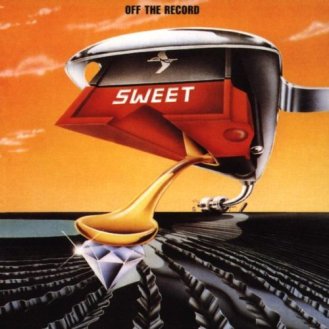
Off the Record – RCA – 1977
Image

Although they would release one more album after Off the Record with Brian Connolly, I feel this is where the young, sassy, energetic and raucous version of Sweet ends and their next LP is where they would emerge looking older, fatter and trying to make more “mature” music so to speak.

Anyhoo, Off the Record is another damn fine, melodic and tuneful LP although it’s a heck of a lot more diverse than Give Us a Wink!.  Whereas Give Us a Wink! is basically a 70s hard rock/heavy metal album, Off the Record incorporates all kindsa different genres.  Sure the quintessential elements are there.  The album still has the hard rock and heavy metal but the band has thrown in other stuff; a ballad, a dance funk tune, a borderline punk song and another NWOBHM tune that comes completely out of left field.  Also the Queen inspired synth and high pitch backup vocal influence is on high throughout.

The tone is set with the uplifting, fist-pumping “Fever of Love”, a bouncing, galloping hard rock tune with a big, happy chorus meant to evoke feelings of positivity and love even in the darkest soul.  Yeah it sounds corny but, hey, we can’t always think of the world as a dark, lonely, cold and loveless place, can we?  Who says hard rocking music can’t be positive?  I’m too lazy so I’m just gonna describe the rest of the songs in list format; this oughta do in capturing the mood and feel of the album:

“Lost Angels” – harmonious synth and backup vocal filled, acoustic/electric anthem
“Midnight to Daylight” – melodic hard rocker (complete with harmonica!)
“Laura Lee” – acoustic power ballad
“Windy City” – down and dirty heavy rock epic
“Stairway to the Stars” – Free-esque rocker (complete with cowbell!)
“Live for Today” – fist pumping, near punk song with awesome shoutalong chorus
“Funk It Up (David’s Song)” – butt shaking, dance funker (complete with shout along lyrics, imitation soul vocals and hand claps!)
“Hard Times” – groovy Deep Purple style grunter
“She Gimme Lovin'” – aforementioned, high speed, metal ripper

Apparently the track list is also different from the European version but as far as I’m concerned, this sequence works fine, especially in ending the album on such a high octane note.

So how’s that for diversity?  Could you imagine Judas Priest performing a straight ahead funk song?  Could you picture Sly Stone performing a raging metal tune?  Once again it’s that type of diversity that I enjoy about the group.

Anyway, the group would follow this with one more album before Brian Connolly hit the road and Sweet would morph into a duller, less flashy version of themselves.  Stay tuned for the fun!


Reviews for rest of the catalog coming soon!

Edgeplay: A Film About the Runaways (2005)

Image

Image

On my facebook page, I humorously remarked about how Lars Von Trier’s Melencholia is probably not the celebratory, good time film with which to bring in the New Year.  The irony is that I thought, “hey!  I’ve got this movie about John Waters’ famous transvestite/character actor pal, or I’ve got this movie about the Runaways, the all female rock band responsible for ‘Cherry Bomb’, one of the gnarliest guitar grunters of the 70s!  No matter which of these I choose, I’m in for a mighty good time!”  And boy was I mistaken!

To further illustrate, remember how in The Filth and the Fury, John Lydon says something about how, unlike every other film about every other band, their movie will show you that being in a band is hard, and it’s hell and only somewhat enjoyable if you do it for the right reason?  Well even that movie showed that, among the scary and tragic moments, there was still joy to be experienced and, in the end, something good came out of it.

With Edgeplay, which was directed by former Runaways bassist Vicki Blue, this is not the case at all.  Instead we get nearly two depressing hours, in which we barely hear a word about music and lots and lots of shit talking and disturbing accounts of a sleazy manager, who used sexual and emotional coercion to shape the Runaways look and sound.

The trouble with the film was imminent the moment former Runaways guitarist and arguably most successful member Joan Jett refused to participate or allow any original Runaways tunes to be licensed for the movie.  In her own words:

“To me, the Runaways is my baby, so you have to understand my perspective. If there’s gonna be a Runaways movie, it should be about what we accomplished, the tours we did, the bands we played with, the people we inspired. I’m not gonna participate in a Jerry Springer fest, bottom line. With any band, you’re gonna have interpersonal conflicts, but if that’s what they thought the Runaways were about—about breaking a bass or putting on make-up—well, it’s very disappointing. Very, very disappointing. I wanted nothing to do with it because that’s not the band I was in. [The film] was a totally different take on what went down.”

The basic Runaways story is that, in 1975 somewhere in L.A., producer/manager Kim Fowley helped assemble a sassy, sexy, all female teenage rock band called the Runaways, which initially consisted of Cherie Currie (lead vocals), Lita Ford (lead guitar), Joan Jett (rhythm guitar), Jackie Foxx (bass), and Sandy West (drums), and marketed them as “jailbait rock.”  Now is that your idea of “Grrrl power”? After the release of their self titled debut album, Jackie Foxx quit and was replaced by Vicki Blue. Then, after their second album, Queens of Noise, Cherie Currie quit, and Jett took over on lead vocals along with playing guitar.  After their third album, they broke up, and Cherie Currie, Lita Ford, and Joan Jett started their solo careers; the end.

On the surface, it sounds like it could lead to some interesting anecdotes, stories about tours with bands like the Ramones, but nope… They mention some of that, but mostly it’s just a bunch of really nasty back biting and harsh attacks.  That Kim Fowley and the subsequent managers employed were probably the sleaziest fuckers in showbiz I have no doubt, and it’s good to expose that; especially that really disturbing “Kim Fowley’s Sex Education” incident, which various members recall differently and became the hot topic of controversy in Cherie Currie’s autobiography.  But there’s no victory at all!  It’s just trashy Entertainment Tonight style shit talking!

Even during the Japanese tours and success stories, there is still an air of tragedy throughout.  Blue interviews every other member except for Jett for obvious reasons.  Although she technically didn’t interview Kim Fowley since he made some absurd demands like insisting on singing his interview answers and then licensing them (?!), Blue managed to secure some VH1 interview footage.  They also interview Jackie Foxx’s and Cherrie Currie’s parents and Suzi Quatro as well.

There is a little bit in there about the music; for instance, “Cherry Bomb” was written on the spot at their first rehearsal; Lita Ford was influenced by Jimi Hendrix and Ritchie Blackmore and could wail on the “Highway Star” guitar solo; their producers didn’t trust certain bass players to play in the studio; half the members wanted to be a metal band, while the other half wanted to be a punky glam band; and several members patterned themselves off their individual idols, with Jett as Suzi Quatro, Currie as Bowie – even though it seems she more has the macho rock swagger of a Roger Daltry or Robert Plant – Ford as Ritchie Blackmore, and Foxx apparently as Gene Simmons (?!).  That’s the kind of shit I wanted to learn about; not how the members all shacked up with each other.

And, as mentioned earlier, we don’t get any original Runaways music; the closest we get are their covers of “Rock ‘n’ Roll” by the Velvet Underground and “Wild Thing” by the Troggs. Instead, the needlessly grainy interview footage and otherwise poorly shot film is spiced up with god-fucking-awful hair metal that was written and/or performed by Lita Ford and Suzi Quatro explicitly for the movie.  And it NEVER stops!  The music just keeps playing in the background as if on loop!  I’m not kidding!  How could Suzi Quatro – responsible for “Glycerine Queen” – make such lousy music?

So that’s the story of the Runaways; six teenage girls got thrown into the music industry machine of sleaze, sex, drugs, rape, unwanted pregnancies, attempted suicides, physical attacks, and broken Nikon cameras, got spit out, and that was it.  Also, apparently, Sandy West shoved loaded guns down people’s throats and broke people’s arms for loan sharks. How cute. No but obviously Lita Ford, Joan Jett and, to a somewhat lesser extent, Cherie Currie launched successful careers and good for them.  But if you’re looking for a film about women triumphing in the male dominated rock ‘n’ roll music industry or something that isn’t just a bunch of depressing ass bullshit, don’t look here.

Vampire Circus (1972)

Image

ImageImageImageImage

First of all, this:

vampire_circus_1

Second of all, Vampire Circus received a PG rating!  Unless scenes were cut for the American release, I can imagine the “hubba-hubba” elation I would have felt if I saw this movie in the theater as a little kid and can imagine my mom or dad angrily whispering, “turn your head, son!”

Vampire Circus is a later period Hammer film that loosely fits into their much steamier later period films such as Twins of Evil, The Vampire Lovers, Lust for a Vampire and Countess Dracula.  Notice they didn’t make Lust for Frankenstein or Frankenstein’s Sexy Nymphs because I don’t think there is any way to make a sexy Frankenstein picture.  And no, Frankenhooker wasn’t sexy.

As indicated above Hammer pictures was moving in a more salacious direction primarily to keep up with the changing trends in cinema and partially just to stay afloat.  In all of that came this remarkable vampire picture, which succeeds in being unique, creepy and, well, erotic.  I would say it borders on European erotic horror films; it certainly has the right amount of nudity for that!  Oh and there’s a surprising amount of gore for a PG rated movie as well.

In the prologue, a young, cute nymphette, Anna Mueller (Domini Blythe) runs to a castle to have a passionate romantic love affair with vampire Count Mitterhaus (Robert Tayman).  Both are caught by her husband Prof. Albert Mueller (Laurence Payne), who looks more like her dad (wonder why she ran way…).  Mueller impales the count but the count promises to get his revenge.  Afterwards Anna Mueller is brutally flogged by the town folk for her lechery and runs back to the castle, which the town folk then burn down.

Fifteen years later a plague has hit the town.  The superstitious people believe it’s the vampire’s curse but Prof. Mueller doesn’t believe vampires exist (after all, he killed the vampire but anyone would die from getting impaled, ya know?).  Then the caravan rolls in!

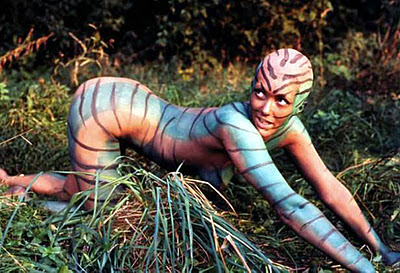
Led by the sexy Gypsy Woman (Adrienne Cori, who looks quite stunning with all that flowing red hair) and consisting of a painted up dwarf, a  strong man, two acrobatic types, a lion tamer of sorts, a naked tiger dancer and Emil (Anthony Higgins) who can shape shift into a leopard, the circus allegedly comes to bring the woa-begotten folk some joy.  They perform various circus tricks and it seems innocent enough – well, as innocent as a completely naked woman painted green with tiger stripes performing a sexually charged dance with the lion tamer in front of men, women and children can be – but soon things take a turn for the worst.

It’s revealed pretty early on that the circus hasn’t come out of good spirits but to avenge Count Mitterhaus.  What’s interesting is that not everyone in the group is a vampire; only the shape shifting Emil and the two acrobatic dancers.  The rest just do their cicusy thing, albeit maliciously.  Remember kids; dwarfs aren’t to be trusted!  The circus people do a variety of bad things whether it be traumatize an old man via a nightmarish carnival mirror, lure a group of people into a forest just to have the very same circus animals brutally ripped them to shreds and of course the standard blood sucking expected of the vampires.  In fact little kids aren’t even safe.

Which leads me to another point.  This movie has some weird overtones of pedophilia.  I dunno, maybe the vampires are just biting the little kids for their blood but, considering what vampirism has always implied, it adds a certain level of creepiness.  Otherwise though, Vampire Circus is an underrated little gem that deserves to be re-examined.  Hammer was going through some rough times financially which prompted them to think a little outside the box and this is a good example of that!

Frankenstein’s Daughter (1958)

Image

ImageImageImage

As I mentioned somewhere else on this blog, the American horror movie landscape was pretty unique in the late 50s and early 60s.  American companies weren’t convinced that traditional, gothic or literary horror pictures could really grab the youth market until Hammer and later American International proved that with their Draculas, Frankensteins and Edgar Allen Poes.  In the meantime, any American horror movies made were set in the present day and any connection they had to classic monsters was superficial at best.

Take for instance this movie I am currently reviewing.  Frankenstein’s Daughter is no more a Frankenstein movie than any other movie about a mad scientist who experiments on bodies to create life.  And quite honestly Frankenstein’s Daughter is a pretty misleading title; the mad doctor’s creation is a female (and barely at that) but the doctor is actually Frankenstein’s heir so shouldn’t it be called Frankenstein’s Great Grandson?  I guess it doesn’t have the same ring to it.

But what’s really great and surprising is how grotesque the movie is for 1958; the scene where the doctor gets a burning chemical thrown in his face could easily earn an “R” rating these days.  The makeup job on the monster is no slouch either.

Frankenstein’s Daughter concerns a mad doctor named Oliver Frankenstein (Donald Murphy) who assists an elderly scientist named Carter Morton (Felix Locher), who is experimenting to create the cure for every disease ever (hey, I didn’t say it was a good script!).  Frankenstein has other plans; to use the laboratory and its resources for his own demented plans to bring the dead to life.  He also has a creepy assistant named Elsu (Wolfe Barzel), who helps round up corpses for the experiments.

Since this is a “modern” horror picture, the protagonists are all teenagers or, rather, people in the their 20s/30s acting like teenagers.  The main one, Trudy (Sandra Knight) is also the niece of Carter and nightly transforms into a hideous monster that attacks people.  Surprise surprise, this occurs when the maniacal Oliver Frankenstein spikes her drink.  But that’s only a sub plot.  The main plot concerns the doctor collecting bodies and eventually assembling his monster.  The monster rampages and does the evil bidding of the doctor and that about covers it.

It doesn’t sound like the most original plot in the world and it’s not.  But it’s fun because the doctor is such a nut job who even makes time to paw after the two female characters between his mad exploits and the monster makeup is awesome.  Kills?  Not enough but one of them has the doctor run down a victim with his car.  Also, in order to further exploit the youth market of the time, there are a handful of rockin’ musical numbers performed by the Page Cavanaugh Trio.

Silent Night, Deadly Night Part 2 (1987)

Image

ImageImageImage

Brilliant!  But first…

silent_night_pic

Ho ho hell, everybody!  Silent Night, Deadly Night caused a whole lot of controversy on account of its having a guy dressed like Santa Clause going around killing people.  It’s an absolute masterpiece that delivers on all of its promises, one of the few movies where, as you’re watching and you say, “get ‘im, yeah, get ‘im!”, he actually “gets ‘im.”  In that one we got to see a topless woman get impaled on a pair of antlers, a boy get decapitated while sledding down a hill and a woman get shot with an arrow.

So does the sequel live up to the first one?  That’s a tough question to answer.  As you can tell by the grade, I enjoyed the movie.  I would have given it four crosses but I think the first problem is the most glaringly obvious one.  Roughly 35 minutes of Silent Night, Deadly Night Part 2 are recycled scenes from the first Silent Night, Deadly Night.  There clearly must be some sort of rule when it comes to giving director Lee Harry 100% of the directing credit when he only directed 55% of the movie.

And there is no second problem.  The rest of the film is totally awesome.  My friends and I have all gotten a hearty laugh from the classic clip of Ricky (Eric Freeman) walking around a happy suburban neighborhood casually dusting off its inhabitants with a revolver and hamming it up with over the top, maniacal laughter eventually leading to his bizarre exclamation of “GARBAGE DAY!!!”  Just like in this video:

Silent Night, Deadly Night Part 2 is mostly told in flashback until the epic final scene.  The movie begins with an adult Ricky talking to his 13th shrink, Dr. Henry Bloom (James Newman), who speaks in a stern, authoritative manner – the type which we anticipate will result in his death – as he tries to suss Ricky’s life story.  Ricky precedes to tell the events, including the 35 minutes (and best scenes from) the first Silent Night, Deadly Night, culminating in little kid Ricky foreshadowing the events of the sequel by uttering, “naughty.”  Ricky’s own story is no less of a bloodbath, in which he saves a woman from a rapist by running him over several times and impales a bully with an umbrella.

I must say the scene where Ricky saves the woman from the rapist is a hoot.  The rapist appears to be her boyfriend who gets too pushy when trying to get his gal to put out and the situation turns into an attempted rape.  The girl fights back and the guy gets up and leaves, which should have been the end of it.  But instead Ricky gets in the guy’s car with the keys still in the ignition and runs him down, rolling back and forth over his corpse.  They even insert a shot of his bloody, twitching arm.  Instead of being frightened for having witnessed a homicide, the woman thanks Ricky.  Wow.

Regardless of his murdering a few people, Ricky keeps it together enough to get a girlfriend.  Even then he exhibits signs of insanity, particularly in the awesome movie theater scene, where the theater is showing a movie about a killer Santa!  I’m not going to say anything else about the rest of the movie because it’s a total riot.  If you’ve seen the entire “garbage day” clip, then you know how the girlfriend situation turns out but the rest of the movie is epic and needs to be seen.  There you go; you have my recommendation.

200 Motels (1971)

Image

ImageImage

Happy 73rd birthday, Frank Zappa!  I like Frank Zappa a lot.  His music and attitude are partially what influenced me to start writing this blog in the first place.  Undoubtedly his snarky cynicism caused by the so-called “peace and love” and “counterculture” movements of the 60s give him the distinction of being a “savage hippie.”  He was a long haired freak but he was completely clean of drugs (except for the cigarettes) and laughed at both hippies and cops.   He voiced disdain for the system, the Vietnam war and people’s willingness to succumb to societal pressure and be mediocre while not supporting the left or right; he bashed goony institutions from all sides and encouraged people to think for themselves.  Above all he made some fantastic music; a hybrid of rock, doo-wop, free jazz, avante-garde, musique concrete and whatever other tricks he had up his sleeve.

In 1971, Zappa came up with the idea of making his very own movie about the life, trials and tribulations of a working rock band.  Unlike his music which, it seems, he took the utmost care to make note-perfect with state of the art equipment and top notch musicians, his movie, he apparently allowed to run slipshod into god knows what.  At least it seems that way.  A lot of people talk about how “way out” and “craaazeee” the movie is and how you need to see it all “fucked up” to get into it.  But actually it just reminds me of a cheaply filmed, Monty Python episode with less good skits and more dick jokes.

First of all it wasn’t filmed.  It was taped.  That’s the first thing the “film people” will notice when watching it.  Zappa, I guess is credited as director alongside Tony Palmer but I don’t know who was doing the real “heavy lifting.”  Second of all, as one might expect, there isn’t much of a story.  The movie didn’t really feel directed; it just felt like a camera was set up and some shit was allowed to happen.  Third and best of all, Zappa or Palmer or whoever, go crazy with the early video camera effects.  It’s so obvious how  the effects were created yet they still look cool; filters, layered film, rewinds/fast forwards, negative effects.  It’s so amateurish looking, high school kids would be able to use these same effects on their home video projects less than a decade later.   Also the sets are completely and obviously fake looking; it sort of reminded me of something in Forbidden Zone or a Guy Maddin film.

The movie features every member of the Mothers of Invention from that period; Ian Underwood, Aynsley Dunbar, George Duke, my personal favorite Jimmy Carl Black and Motorhead along with Flo and Eddie.  The best parts of the film are the performances, which were done live and are all top notch.  I also really liked the animated sequence which I will discuss momentarily.  Frank Zappa barely appears in the movie, instead opting to play guitar in one segment and drums in another.  The rest of the band do a bunch of stuff, none of it particularly interesting or worth mentioning.  Also Ringo Starr and Keith Moon have cameos and the Royal Philharmonic Orchestra perform in the film as well.

During the film we see topless groupies, a living vacuum cleaner, people with funny masks sitting in a fake saloon, Ringo Starr pretending to be Frank Zappa, Keith Moon dressed as a nun and threatening to overdose on sleeping pills while hanging with said topless groupies, idiotic discussions about the differences between dicks and penises and Jimmy Carl Black shooting at a target that says “hippies” on it.  I’m sure other stuff happened but I don’t feel like digging into my memory sack.  I feel a little embarrassed for Ringo, who is forced to talk about putting a genie’s lamp into a woman’s reproductive organ.  Come on, Zappa, you thought that was funny?

Now then, the animated sequence is easily the best part of the movie; it’s not the most original thing but it involves an acid trip, hippie mumbo-jumbo, Monthy Python-esque collage art and name-drops Black Sabbath and Coven.  I could easily see it as a standalone piece.  There’s really nothing else to say about the movie.  It’s not exceptionally funny nor does it really offer any true insight into the lives of working musicians.  The dialogue is apparently pulled from real life but, so what?  Really this movie is for Zappa fans because I honestly cannot picture the average person being able to stomach more than 20 minutes of it.

Vampyres (1974)

Image

ImageImageImageImage

Further proof that the 70s were the best decade in film making.  In what other decade could you release a movie that literally sits on both the horror and erotica fence?  You can’t have “erotic” films anymore.  You can either have porn or horror.  Vampyres is one of the few erotic films I’ve seen (and I’ve seen a lot!) that manages to go in both directions seamlessly without seeming forced.  The movie has a lot of nudity and sex, perhaps even gratuitous amounts but it also has copious amounts of blood and gore as well.  And best believe these aren’t “sexy” vampires who “sexily” suck someone’s blood but rather just vicious killers who happen to be sexy.

This reminds me; I was supposed to review Daughters of Darkness, which I also liked a lot but I totally forgot about.  Now I have to get it again on netflix because it’s been about a week since I’ve seen it and I don’t trust my memory nor do I want to just read through other IMDB reviews.  Dammit.  Oh well.  I was reminded of that, by the way, because Vampyres is also known in some markets as Daughters of Dracula and that’s a similar sounding name.

Anyway, as I was saying Vampyres is both sexy and scary.  It was directed by José Ramón Larraz and has a totally stylish, Eurotrash look combined with a creepy atmosphere and takes place primarily in a neat looking gothic mansion and the vast, lush, green field and forest outside the mansion.

The film is about a vampire (vampyre?) couple – darker, brunette Fran (Marianne Morriz) and lighter, blonde Miriam (Anulka Dziubinska) – who stalk, seduce and kill their victims.  Their primary mode of action is to take turns hitching rides from the side of the road to the mansion, inviting the strangers in and having their way with them. However, as demonstrated by Fran’s actions, the undead need sex too; in between taking giant gulps of human blood from her victim she also has time for some good ol’ fashion humping.  During the couple of tasty shack ups, the male victim wakes up, sees giant slashes on his arms and feels more and more tired daily.  What a way to go, huh?  Miriam, on the other hand, is strictly a lesbian as demonstrated by her never taking part in sex with the men she kills and lusting only after Fran.

The story begins as a complete stranger walks in on Fran and Miriam as living people in the throes of passion and inexplicably shoots them dead.  Then the credits role and we’re introduced to the three main characters, a sort of rich playboy type (Michael Byrne) who, I guess, is on vacation or something and the cute, young couple John (Brian Deacon) and Harriet (Sally Faulkner), who decide to go camping near the mansion.  As the story progress, Harriet begins to notice weird stuff happening, including a person screaming right outside her window.  As expected, when she wakes up her lover, the man is gone and all he has to say is, “see, honey, you were just dreaming!”

There are a few other victims and some bodies found mangled in car crashes on the side of the road but, most importantly, there is sex and gore.  There’s also a sexy shower scene between the two vampire ladies and there is one particular kill sequence that displays that, just because Miriam is a lesbian, does not mean she treats the living female character any more kindly.  This is one of the finest in the eroto-horror/sexy vampire sub genre.

Christmas Evil (1980)

Image

ImageImage

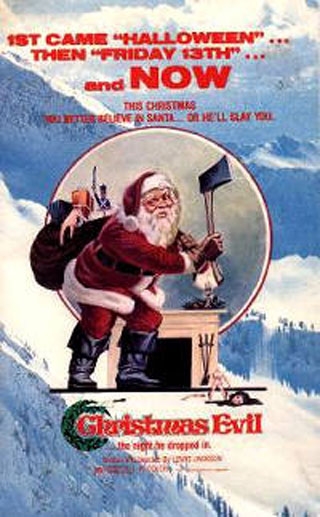
Have you ever watched a movie and thought, “man, this has too much good taste?”  I know what you’re thinking; yes, Christmas Evil (a.k.a. You Better Watch Out and Terror in Toyland) from writer/director Lewis Jackson may have pre-dated Silent Night, Deadly Night by four years and how tasteful can a movie about a killer Santa really be?

To be sure, the plots for Christmas Evil and Silent Night, Deadly Night are pretty darn similar save for a few little details.  Like Silent Night, Deadly Night, the movie begins with the killer’s childhood, where he witnesses a traumatizing event that eventually manifests in his adult life, resulting in his going on a killing spree while dressed in a Santa costume.  What’s surprising is that the event in Christmas Evil could probably be explained by a simple talk of the “birds and the bees” (Santa getting it on with mommy).

Years later it’s revealed the boy in the opening sequence has grown into a lonely, pathetic man-child named Harry (Brandon Maggart) who has creepily filled his home with nothing but Christmas decorations and Santa toys.  At night he works in a factory with typical assholish types, one of whom takes advantage of his generosity and convinces him to switch shifts with him only later to reveal to his buddies how he “suckered Harry into taking his shift.”  In addition to that, Harry closely watches the neighborhood children, taking note of who’s been naughty or nice.  He catches one boy reading Penthouse, thus making him not “nice.”

Harry suppresses is rage, of course making everyone around him think that he’s just an eccentric but harmless man.  So far, so good.  You’re just anticipating the brutal payoff, the moment when Harry will snap and go on a rampage just like the killer in Silent Night, Deadly Night.  So we finally get to that crucial moment when Harry glues on the Santa beard, puts on the costume and arms himself with a knife and nutcracker doll with bayonet.  And then…

Major freakin’ letdown!!!

There are so many people in this movie; all those people at the company Christmas party, the neighborhood children, Harry’s own brother and his family, all those potential kills and only four people get it!  The asshole guy who tricked Harry into taking his shift is one and three completely random people on the steps of some memorial site and that’s it!  The rest of the movie is Harry either running or driving away from trouble!  Can you imagine my major disappointment when there’s a whole mob after Harry and Harry doesn’t run them down with his van?  What’s his problem?  What’s the problem of the filmmaker?  What’s with that stupid ending where Harry drives to the moon?

I really hope Lewis Jackson wasn’t trying to make a “serious” character study.  I’d like to chalk it up to a poorly written, poorly paced script and very few shocks.  Have you seen Silent Night, Deadly Night?  That’s the one where Santa impales the woman on a pair of antlers and decapitates the kid sledding down the hill.  Don’t expect anything even remotely that cool to happen.  Yes, in this movie, Santa stabs some people but other than that.. what wasted potential!

The Curse of the Living Corpse (1964)

Image

ImageImage

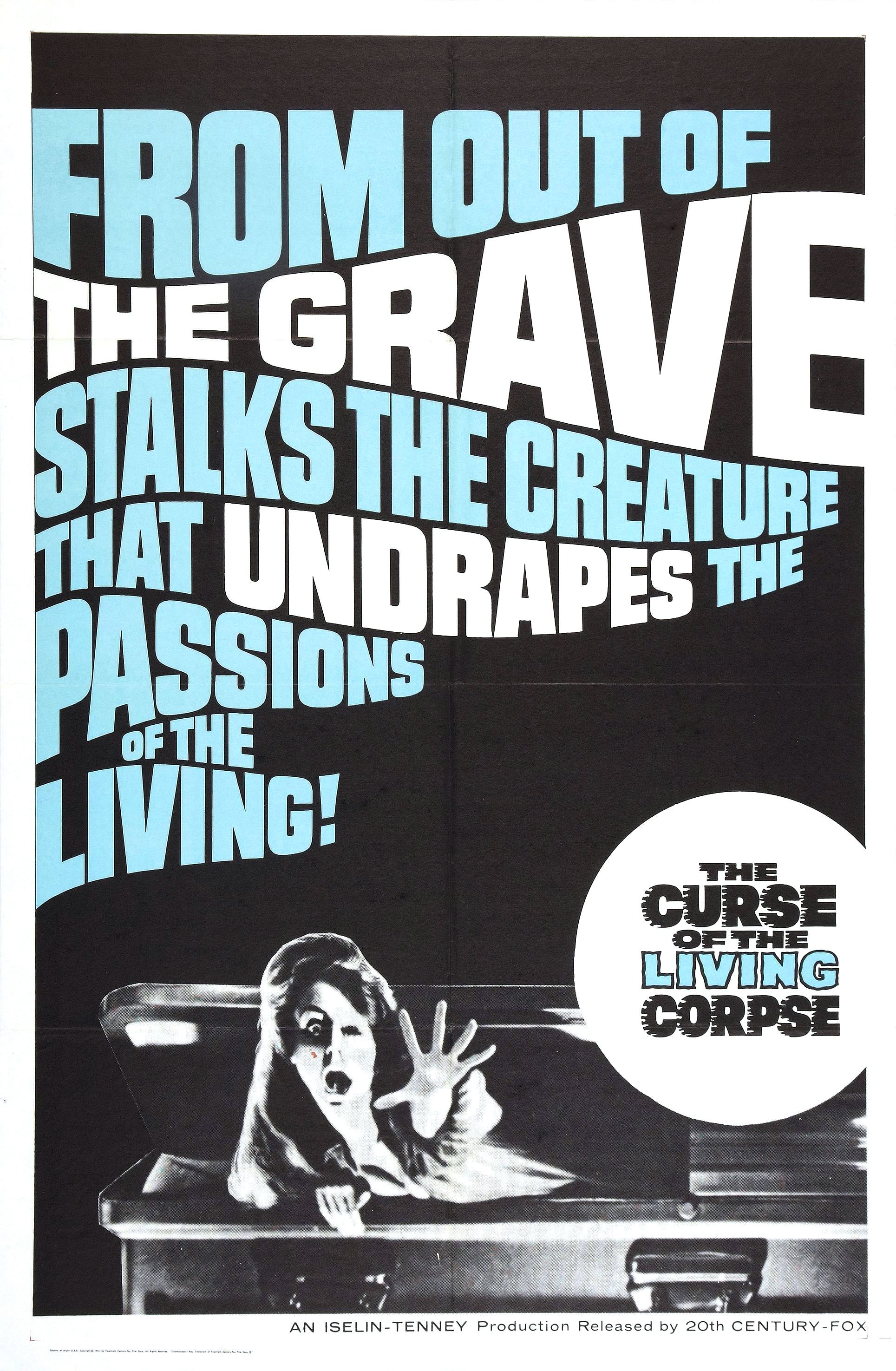
Now that’s just ridiculous.  There is no creature that “undrapes the passions of the living” in The Curse of the Living Corpse.  It’s clear from the first stalk and kill sequence that the menace of the movie’s namesake is just a guy with a hat and cloak and that there are no supernatural elements in the film.  To be honest, though, two crosses seems a little low for a movie which had some pretty neat sequences but three seems a little high for a movie I didn’t enjoy all the way through.  If any of you loyal readers can render me an image of a “half cross”, then I’ll amend this post by using it!  Thanks in advance!

Coming from the same Del Tenney double feature DVD as The Horror of Party Beach, I was little a disappointed that The Curse of the Living Corpse didn’t give me the same charge as the other film.  It was going places at first but sorta began meandering into needless comic relief and endless scenes of nothing going on, which strung together the few gory and suspenseful sequences.

The plot is pretty basic; set in New England in 1892, a rich man’s heirs stand to inherit his will given that they follow his post death instructions properly.  Of course none of them do and allegedly, the old man leaves his grave and begins picking off his ungrateful, unruly kids, their spouses and some other hangers on one by one.  This group of WASPs includes the non-WASPy Roy Scheider as a smart ass alcoholic named Philip, Philip’s brother and failed doctor Bruce (Robert Milli), Bruce’s main squeeze who I think is played by Linda Donovan, Philip’s wife Vivian (Margo Hartman), Philip’s and Bruce’s mother Abigail (Helen Warren), the caretaker Seth (J. Frank Lucas) and some other guy whose name I forgot.

The film is made well and has some neat sets, primarily the tomb where the father’s body is kept and the old looking mansion they all live in.  The kill scenes are superb; you get a head on a plate, a bloody face, a live burning and a bathtub drowning and some of the characters are completely, hilariously self centered, especially Bruce, a domineering, womanizing pig.  So yeah, it’s fun watching them get picked off.

What’s not fun is the sort of meandering, roundabout way in which the events happen.  They need to make this shit snappy, come on!  Also, what’s with the goofy cop who accidentally handcuffs himself and gets coerced into drinking booze, passing out and waking up hungover?  How is the film supposed to keep its sense of creepiness and suspense with all that tomfoolery going on?

Oh well, it’s not perfect.  On the plus side, there’s some borderline nudity in the bathtub scene.  In the U.S., official “above waste” nudity is constituted by the exposing of a nipple or two, which didn’t happen due to the way in which Margo Hartman was positioned in the bathtub; if she just sat up a bit… also the twist at the end does come as a surprise.  I just wish the movie was more evenly and quickly paced.

Mudhoney (1965)

Image

ImageImageImage

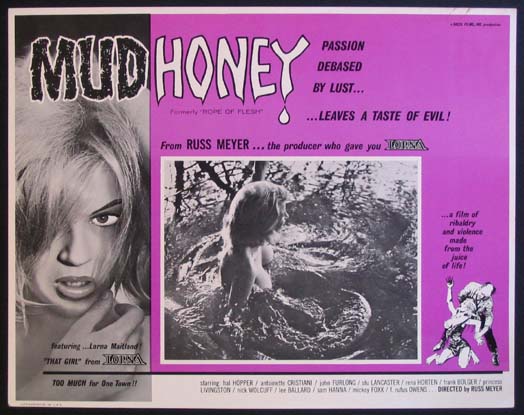
I finally saw the movie from which one of my favorite bands got its name.  I guess I don’t really “get” Russ Meyer.  I’ve seen Faster, Pussycat! Kill! Kill! and Beyond the Valley of the Dolls and I found those and Mudhoney entertaining enough.  I guess they’re supposed to be a mix of satire with some titillation?  Mudhoney is certainly well made – albeit with a couple continuity jumps – and has its tense dramatic moments but was he just trying to make trashy melodrama?

That might be the issue I have with the movie; I’ve seen films like Common Law Wife, Jenny Wife/Child and Shanty Tramp and I watched those for their shoddy film making, antiquated look and occasional nudity.  Meyer’s film isn’t nearly as shitty as the crap Something Weird puts out yet seems too trashy to be taken as “real” cinema.  Was he trying to be the b-grade Douglas Sirk?

For those unawares Mudhoney tells the depression/prohibition era tale of a hired hand named Calif (John Furlong) who comes from Detroit to some non-disclosed location in the deep south where he begins working for a farm owned by some guy (forgot the character’s name) and his hot, blonde niece Hannah (Antoinette Cristiani).  Only problem is that Hannah is married to an abusive, alcoholic nut job named Sidney (Hal Hopper) who, along with raping and beating his wife and visiting the local whore cabin, plans on inheriting his wife’s uncle’s farm when the old man kicks off.

Naturally the story heats up when it’s revealed that Calif has a thing for Hannah and, given that Calif isn’t an abusive drunk like her husband, she likes him back.  This creates all kinds of tense and melodramatic situations; Hannah screams a whole lot and even finally fights back against Sidney.  Meanwhile Sidney also attempts to get the townsfolk against the hired hand through the help of a naive preacher.

In my opinion the movie would be a tad more dull if it weren’t peppered with colorful side characters, most of whom inhabit the local whore cabin I mentioned earlier.  This tacky bunch definitely add a lighthearted if a bit sleazy touch to the story.  Eula (Rena Horton)  and Clara Belle (Lorna Maitland) are two hot, busty blondes.  The former is a deaf mute and both bathe nude outside and are always horny.  In fact Eula ingratiates herself to the local preacher who, after doing his thing, yells “sinner!” to the amusement of the rest of the group.  The barn is tended to by the hilariously weird and ugly looking Maggie Marie (Princess Livingston) who jovially exclaims about how she hasn’t turned a trick in 15 years.

The film does make its statements on morality.  The preacher accuses everyone of being a sinner while the inhabitants of the happy whore cabin basically celebrate their sexual freedom.  Yes we see both Eula and Clara Belle naked and yes, it’s meant to excite – I mean, come on – but both scenes have a natural, carefree tone about them.  Clara Belle even says to Calif, “oh you’re one of those city boys who uses a bathing suit.”

But the main crux of the story lies in what Sidney does and, indeed, he’s one awful son of a bitch.  I don’t want to give too much away but he does some pretty selfish, mean-spirited and downright sociopathic things eventually leading to the film’s cataclysmic conclusion.  The ending is pretty epic.

Overall the film is pretty entertaining.  The opening sequence of Sidney driving drunk, storming into his own house and raping his wife – as awful as that is – does an excellent job establishing the twisted, white trash world we are about to enter.  Is that the point then?  Should I re-rate this movie and give it four crosses?  Only time will tell!