From Beyond the Grave (1973)

Image

ImageImageImage

First listen to this:

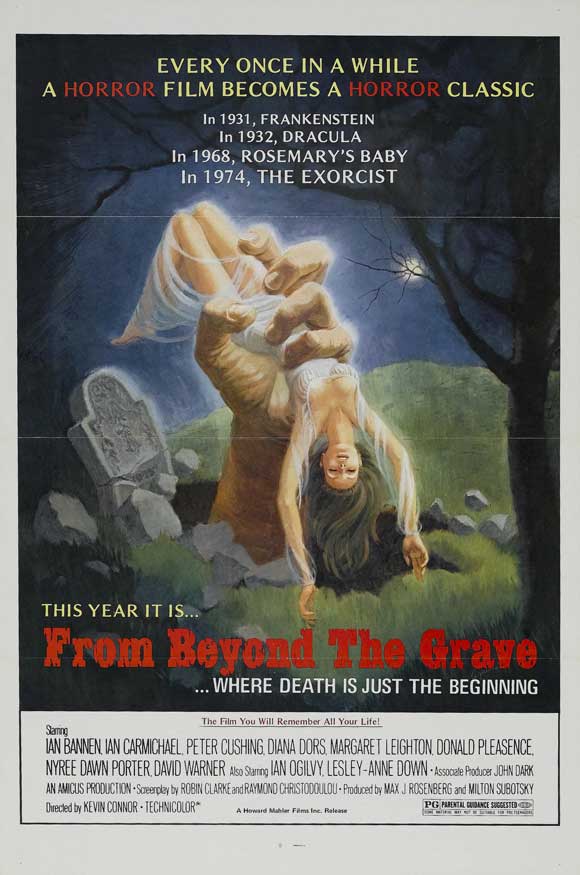
I love anthology films so it’s not a big stretch that I would enjoy Amicus’ From Beyond the Grave.  Granted I didn’t quite understand what happened in two of the stories and the way in which all four stories were connected didn’t make sense so when I give this film a 3 out of 4 iron crosses, it’s more for me than for you, cool?

The movie has a lot of promise since all four stories are loosely connected to an antique shop run by an old Scottish man played by Peter Cushing.  I understand what the movie was going for because each of the stories begins when its lead character visits the antique shop and purchases an item and then that item supposedly becomes the central theme of the story.  However, in two cases, the item had nothing to do with the story.

The other weird thing was that the stories didn’t follow the same flow; in most of these anthology films, there’s a set up and a twist.  But in a couple of these, there is no twist to speak of.  And in one case, the twist didn’t really make sense or I just didn’t understand it.

The first tale begins when a man named Edward (David Warner) purchases an old mirror, conducts a seance and sees a weird dead guy in the mirror.  He tells him to go kill people to feed his hunger for souls until he is satisfied.  The set-ups and killings are cool; including several where he picks up hapless young ladies either off the street or in a dimly lit hippie club.  However, the story drops the ball with the ending.

The second one is the best even though it has nothing to do with the shop.  The lead character played by Jim Underwood steals a military medal he didn’t earn from the shop, takes it home, meets Ian Brennon on the street and has dinner with his family, plans a voodoo killing of his annoying wife and then marries the man’s daughter.  I’m not going to spoil the ending since it’s a doozy!

The third one is about a man who meets a medium on a train and she tells him that he has an “elemental” on his shoulder.  He can’t see it so naturally he thinks she’s crazy.  But later that day his wife starts experiencing the elemental’s presence through physical attacks and soon they call the medium to exercise the elemental.  It’s a neat story but the ending makes no sense at all.

The last one is the silliest.  William Seaton buys an antique door which he uses for his closet and the door opens another world.  There he is attacked by Sir Michael Sinclair (Jack Watson), some guy with a sword.  He destroys the door and world behind it.  The end.

I’m sorry.  This was probably the most boring review you’ve ever read.  Let me stress that I liked this movie because I like the atmosphere and the gothic sets in Hammer and Amicus films but I don’t recommend it to the discriminating movie watcher who cares about things making sense.

Van Der Graaf Generator

Image

special introductory paragraph
The Aerosol Grey Machine
The Least We Can Do Is Wave to Each Other
H to He Who Am the Only One
Pawn Hearts
Time Vaults
Godbluff
Still Life
Maida Vale
World Record
The Quiet Zone/The Pleasure Dome
Vital
Now and Then
Present
Real Time
Trisector
Live at the Paradiso
Live at Metropolis Studios 2010
A Grounding in Numbers
ALT

Note: I apologize for this page being incomplete. I let it go live without reviewing every single album. If you click on a link and it doesn’t take you to an album or the review doesn’t exist yet, I’m working on it!

I first heard of Van Der Graaf Generator because Mark E. Smith, John Lydon and Nick Cave all claimed they were fans of the group.  Although now I absolutely love their stuff, initially I had trouble getting into them because their sound is so weird!  On one hand they appear to be just another progressive rock group to have emerged from some British art school in the late 60s that wanted to extrapolate on their chops and push the musical envelope a little further. However one listen to any of their classic albums tells a different story.

First of all singer/composer/guitarist/occasional pianist Peter Hammill has no ordinary voice. At times his singing is so high, feminine and wussy, he makes Jon Anderson seem like a tough guy while other times he caterwauls like a police siren or a screeching woodwind instrument while delivering his lyrics in a highly melodramatic fashion. Second of all, and although they would make their songs a tad more accessible, Van Der Graaf Generator songs tend to violently bounce between sublime, quiet piano music and ragingly loud, discordant, free jazz noise thanks to the musical skills of pianist/organist Hugh Banton, saxophonist/flutist David Jackson and percussionist Guy Evans.

And then there’s Peter Hammill’s lyrics; at times they’re clever and sophisticated like Brian Ferry, other times extremely bizarre and pseudo-philosophical and yet at other times, filled with self-pity. Personally though I prefer the ones about the killer fish at the bottom of the sea.

The Aerosol Grey Machine – Mercury – 1969

Aerosol_Grey_Machine

Okay, I lied.  They didn’t start off with the aforementioned lineup.  The members listed on the back of The Aerosol Grey Machine include Peter Hammill, Hugh Banton and Guy Evans but, unfortunately, David Jackson wasn’t in the band yet.  Therefore there were no noisy sax blasts that would appear as early as their next album and make their music that much more fun.  Instead we have a Keith Ellis on bass and Jeff Peach on flute.

While there is definitely early signs of the type of music Van Der Graaf would become more famously known for throughout The Aerosol Grey Machine, for the most part, the album has a serene, late 60s vibe to it.  Most of the songs consist of pretty acoustic guitar strumming and simple, gentle melodies accompanied by piano and occasionally flute.  Banton’s Farfisa does appear on the album, especially on darker songs like “Necromancer”, the tail end of “Aquarian” and album closer, “Octopus” while “Into a Game” definitely uses sad minor notes.

But, overall the album is happy and hippie-dippie sounding.  There are “show-offy” moments of flute and organ solos but the beats and song structures remain pretty normal.  That’s okay though!  The songs are still great!  Peter Hammill’s unmistakable high pitch voice is already in place but he he doesn’t caterwaul and shout as aggressively as he would on subsequent releases.

On a lyrical tip, even here we see signs of what would come; specifically “Necromancer” is about a “white magician” warning off a those into the “black arts”, a theme which would be revisited as early as the group’s next album but, for the most part, it’s just hippies-laying-in-flower-field-la-dee-da lyrics.  It was the late 60s, whadaya want?

Did I mention the song “Necromancer”?  It goes, “I am the Necromancaaaaahhh!!!”  It’s cool!

The Least We Can Do Is Wave to Each Other – Charisma – 1970

van_der_graaf_wave

Apparently, The Least We Can Do Is Wave to Each Other is supposed to be the real Van Der Graaf Generator debut album; I guess the first one was supposed to be a Peter Hammill solo album but then the rest of the members became part of the official band?  This here second Van Der Graaf Generator album is closer to what you and I have come expect from the group and it’s AWESOME! I think one thing people other than me tend to not notice, if you replaced David Jackson’s saxophone with an electric guitar, Van Der Graaf Generator would sound like a slightly weirder heavy rock band. For the most part Jackson plays rhythm sax, preferring catchy riffs over endless soloing while Hugh Banton backs it up with little melodies on his keyboard. Goes to show that this band is more about sound, mood and melody than crazy arrangements and complicated time changes. There are a few on the album but none that seem to be too mind boggling, I don’t think.

The Least We Can Do Is Wave to Each Other consists of six songs of varying lengths. Most of them move from part to part in a natural but by no means boring fashion, with several building in intensity until coming to their cataclysmic conclusions. Both opener “Darkness (11/11)” and the Inquisition, persecution towards black and white magic practitioners epic “White Hammer” end with especially noisy, discord. I guess I should also mention that Van Der Graaf are slack on guitars; Hammill plays some catchy little, individual note melodies on his acoustic during the quieter parts of album closer “After the Flood” and Robert Fripp contributes some wicked, fuzzed out licks on “Whatever Would Robert Have Said?” but, as you might have guessed, the majority of the instrumentation is handled by sax and keyboard. Jackson also jams out on his flute along with playing corny, renaissance King Arthur melodies.

Possibly the biggest turnoffs for potential fans might be the songs “Refugees” and “Out of My Book.” The former is a soft, piano driven piece accompanied by high pitch, feminine singing and the latter contains aforementioned renaissance era flute. However, if you can see past that, then you might enjoy these for what they are; very pretty and melodious songs. Also check out Banton’s kewl church organ tones at the beginning of “White Hammer.”

And if you want a specific example of what deep, important matters concern Peter Hammill, check out these lyrics:

In the year 1486, the Malleus first appeared
Designed to kill all witchcraft and end the papal fears
Prescribing tortures to kill the black arts
And the hammer struck hard

Malleus Maleficarum slaughtered and tortured
All those under suspicion, as the inquisition ordered
Burning black hearts and innocents alike
Killing the mad, such was the power the hammer had

Though Hexenhammer was intended to slay only evil
Fear and anger against magic overspilled
They also killed those of the white

So for two centuries and more they tried to slay
Both the black and the white arts but spirits override pain
For every one that the torture took, two were hid secure
And so the craft, yes, it endured

Love and hate lived on in the face of fear
Hexenhammer’s force died
And the real power became clear

White Hammer no more is beaten, now it begins to beat
And the gray, once oppressor now at good hands, faces defeat
And the black, too, shall bow down to the power above
Black hate beats gray but supreme is
The white hammer of love, the white hammer of love

Some might say that those lyrics are nerdy.

H to He Who Am the Only One – Charisma – 1970

Van_Der_Graaf_H_To_He_Who_Am_The_Only_One

H to He Who Am the Only One is a heavy album that doesn’t rely on distorted guitar riffs. That’s what makes this band so unique – that the saxophone is primarily a rhythm instrument, playing what would amount to heavy metal riffs if played on guitar.  Also H to He Who Am the Only One is the record that made me a fan. The big noticeable change from The Least We Can Do Is Wave to Each Other and H to He Who Am the Only One is an overall higher reliance on whacked out, abrupt time changes and way more instances of noisy free jazz. If I’m not mistaken these elements are what many find off-putting about the band and possibly why people like John Lydon and Mark E. Smith like them so much.

For instance, opening track “Killer” begins with this killer, angry riff played on sax and organ.  A brooding voice then sings “So you live at the bottom of the sea and you kill all that comes near you/but you’re very lonely because all the other fish fear you/and you crave companionship and someone to call your own/because for the whole of your life, you’ve been living alone” before the organ plays a tense, dramatic build up and then the first verse comes back in, followed by the organ part and then it changes to this happier, rockin’ part and then the crazy sax part comes in, prompting my friend Zach to remark, “Edwin, it’s too early and I’m too hung over for this free jazz freak out!” Also, both Ian O’Brian and I noticed how the end of each line, where Hammill goes, “you-oo-oo-oo-oo-oooo” sounds a little like the end of the “Iron Man” riff.

After a brief, six minute detour into the soft, piano ballad “House with No Door”, the rest of the album caries on in similar fashion as “Killer.” All of the songs (including “House with No Door”) are great but individual parts are worth noting – the whirling, organ intro and similarly noisy Hammond breakdown to “Lost”, the flute/organ interplay and tense, angry build ups in “The Emperor in His War Room”, the spacey noises and driving riff in “Pioneers over C” and many other fine examples!

And yes, it may be difficult to take Peter Hammill seriously with his overwrought and melodramatic vocals and ridiculous lyrics like “live by sword and you will die so/all your paths shall come to naught” but I’ve personally come to enjoy his vocals and lyrics quite a bit. Especially the man blasting off and getting lost in space theme of “Pioneers over C”, which takes place in the futuristic year of 1983, no less!

“It is so dark around, no life, no hope, no sound!”

Pawn Hearts – Charisma -1971

van_der_graaf_pawn_hearts

I don’t know which album I’d tell someone to listen to first if suggesting a Van Der Graaf Generator album because between what I and other people prefer differs but if I’m trying to make someone vehemently hate the band, there’s no better album to do that with than Pawn Hearts.

It’s not as if the group was particularly accessible in the first place but this three song, 45 minute long LP is one dense and challenging piece of work!  When I first heard the album, I immediately liked the noisier bits.  The album’s opening track “Lemmings (Including Cog)” starts with a soft part, prompting a lady friend of mine to laugh out loud and exclaim, “is that a GUY?” but then the noisy “dee-do, dee-da” part abruptly comes in and the song gets all loud and the sax starts bleating away but then it gets quiet again.  And it’s this ugly/pretty, loud/quiet, scary/pleasant motif which dominates the record.

When the songs aren’t loud, Hammill sings in his wussy, high pitched voice over light piano melodies or acoustic guitars for minutes at a time.  What the hell is this crap?  And it sure doesn’t help that the third song “A Plague of Lighthouse Keepers” is a 23 minute, ten part medley!  You have to listen closely to suss enjoyment out of the record but it sure does pay off. There are a lot of things to listen for – bits, dodads, sounds, melodies, Hammill’s “ah-ah-ah-ah” imitating the distorted Farfisa organ during the loud part in “Man Erg” for instance, the sound of the ship horn in the fourth minute of “…Lighthouse Keepers”

I guess you can say Hammill uses his voice as an instrument, going up and down the note scale as a saxophone or trumpet might do. I guess this influenced John Lydon’s singing style in Public Image Ltd. 

And check out some of these lyrics. They’re surprisingly violent and dark!

“Greasy machinery slides on the rails
young minds and bodies on steal spokes impaled
cogs tearing bones
cogs tearing bones
iron-throated monsters are forcing the screams
mind and machinery box press the dreams.”

“But stalking in my cloisters bang the acolytes of doom
and Death’s Head throws his cloak into the corner of my room.”

“When you see the skeletons of sailing-ship spars sinking low
you’ll begin to wonder if the points of all the ancient myths are solemnly directed straight… at… you…”

Indeed Hammill’s lyrics are philosophical and apocalyptic but I’ll be damned if I understand what they’re about!

Then the band broke up and got back together a few years later.

The Battle of Love’s Return (1971)

Battle_of_Love's_Return

ImageImageImage

Remember how when I reviewed Lloyd Kaufman’s first film, The Girl Who Returned, and I said the main reason I gave it 3 out of 4 is because I was just so excited to see an early student short from the creator of the Troma universe (don’t get me wrong, I still liked the film but don’t know how much many others would)?  Well, in this case, the 3 out of 4 grading comes from more of an objective viewpoint (well, as objective as you can be when you’re expressing your own opinion but still).  I actually do recommend the film provided that you know these two caveats: Lloyd Kaufman is a shitty actor and The Battle of Love’s Return is a Godard/Brecht inspired “art film.”

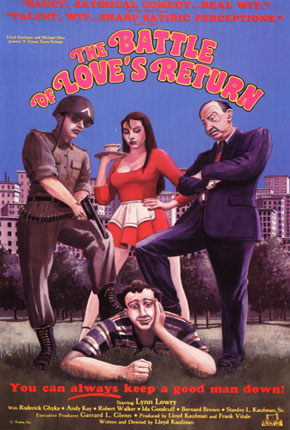
I use “art film” in ironic quotes more to attack the notion of the “art film” rather than to say that The Battle of Love’s Return isn’t art, get me?  In spite the humorous looking poster, this film is comedy in the loose sense.  There are funny moments but the overall objective, I do not think, is just to make you laugh or something.

But first, before we get to it, let me explain something.  The common folk view Troma as a z-movie company who offer nothing more than a few cheap laughs from lousy films.  The slightly more astute film watcher catches that Lloyd Kaufman is actually a good filmmaker and employs his knowledge of film history in his work, often making inside references such as the Buster Keaton gag in The Toxic Avenger Part III: The Last Temptation of Toxie, where the Toxic Avenger attempts to kill himself by standing in front of a tunnel anticipating getting hit by an automobile only to realize the approaching headlights come from a pair of motorcyclists who pass by on either side of him.

And then there are assholes such as me and some French people who go as far as to call Kaufman’s work Brechtian.  YOU might excuse the lack of continuity, non-seamless direction and cheap special effects as bad film making but I give my man the benefit of the doubt and say some of that is deliberate.  Or as Lloyd Kaufman once put it; “continuity is for pussies.”

So what does this have to do with The Battle of Love’s Return?  Well the film jumps back and forth between the minimal narrative to interviews with the actors.  The interviews are shot in black and white and you can hear the crew yell at Kaufman during the filming of these scenes.  The story concerns perpetual loser Abercrombie (Kaufman), who struggles at every turn to fit in, do a job correctly or just win the affections of “Dream Girl” (Lynn Lowery) who angrily calls him a joker after he attempts and fails to operate an elevator.  Elsewhere Abercrombie tries to help an old lady cross a busy street and in turn, receives her abuse.  At other times he tries to join a group of hippies and the military only to be rejected by both groups.

The narrative portions are okay but the meat of the film comes from the interviews some of which include Lynn Lowery pre-Shivers, a hippie beatnik street poet, a Socialist party member turned preacher, an adult bookstore owner and an old lady who immigrated from somewhere in Eastern Europe (I forgot the specifics since it’s been a week since I’ve seen it so I apologize for that one).  There were probably a couple others I don’t remember but I’m reproducing this from memory so don’t shoot me if I forgot anyone.

And, again, if you’re on the Easter egg hunt, look out for a young Oliver Stone somewhere in this movie.

Satanis: The Devil’s Mass (1969)

Image

ImageImageImage

I understand that Satanis is supposed to be viewed as camp since its video and DVD distributor is Something Weird and not Criterion.  And furthermore, this documentary about Church of Satan founder Anton LaVey is plagued with the typical problems –  mainly there are too many talking heads and it’s boring as fuck – but, if a documentary’s primary purpose is to inform and teach you something you didn’t know, then it certainly accomplished that.

I don’t take Satanism any more seriously than voodoo, white magic, black magic or witchcraft.  I throw them all in the same juvenile pot of goofiness that serves as a bit of fun on Halloween (or hell, any time!) and that’s about it.  And I’m assuming my ultra hip, post modern friends feel the same way.  However, I’m not everybody and henceforth, it’s come to my understanding that real Satanic cults have actually murdered people and there were those church burnings in Norway from the black metal kids (yeah, I know they’re not Satanists.  They’re Odinists).  And then I saw this:

If you didn’t watch the clip, basically, Anton LaVey’s daughter Zeena and her husband or fiance Nicholas Schreck are self proclaimed Satanists and Social Darwinists; they apparently held a faux-fascist rally in which they watched the video of the Tate-Labianca murders and they rationalize the Holocaust as a reaction against the Judeo-Christian influence on modern society.  And I thought; is this what Anton LaVey taught them?

NO, NO and NO again!!!

Initially, when I saw Anton LaVey’s photograph, I pictured him as a humorless “intellectual” who speaks really slowly and tries to be philosophical.  But nothing could be further from the truth!  In spite of his “evil” demeanor, he’s a jolly, slightly overweight guy who talks about the Church of Satan and his beliefs like you would talk about the football game!  I mean, he’s right isn’t he?  The Christian church makes you feel guilty for having premarital sex or being a homosexual.  And he stands against that.  All of his followers are hippie weirdos who enjoy a good ol’ romp in the sack and hanging out in dimly lit rooms.  And their attitudes are very liberal; quite the opposite of those held by his daughter and Nicholas Schreck.  At first I thought, “what got lost in translation?”  Then I realized: Zeena LaVey isn’t very smart.

Like I said, the documentary is very boring.  Out of 86 minutes, at least 30 could have been cut.  There is just too much talking!  But some of LaVey’s buddies sure are fun!  There are a couple of queers, an adorable old lady who blatantly proclaims “I hate bigotry in all its forms” and what I think is a lady but looks like Mick Jagger with saggy boobs.  And I know this because she/it did her/its interviews naked.

On the plus side we get to see inside a Satanic mass which did not include the spilling of goats blood or live human sacrifices.  Instead the mass scenes included Anton LaVey wearing a hat with devil horns, some people wearing funny Halloween masks, a few naked people leaning up against an inverted pentagram and a few folks chanting their gibberish as the proceedings went on.  Some of them even looked a little embarrassed on camera.  There’s also a segment addressing the story of when LaVey adopted a baby lion; “it was cute at first since it was like a big cat but those things grow up.”  Hahahaha!!!

The funniest segments, however, were the interviews with LaVey’s neighbors.  All of them treat him and his “church” as a case of an overgrown manchild living in a world of his own creation.  Also, why can’t he cut his damn lawn?  It’s too funny.

Hail Satan!

Public Image Ltd. – First Issue (reissue)

Image

ImageImageImage(out of 5)

I know I’m not going to win any friends with this review but you all like honesty, don’t you?  Light In The Attic has reissued the first Public Image Ltd. album and I’m a fan of their reissues; beautiful fetish objects loaded with liner notes, photos and other assorted memorabilia – if you haven’t picked up their reissue of the Monks’ Black Monk Time, stop reading this now and go get it!!!

The reissue for First Issue or Public Image – First Issue or whatever it’s called is no exception.  Light has released it in several packaging options including one with a bonus b-side to the “Public Image” single called “The Cowboy Song” and a 56 minute long BBC interview.  Also, considering that the original album was never officially released in the states and that the only CD issue is from 1986, the album was due for a retooling.

However, and I say this as a pretty big PiL fan (I have the dang logo tattooed on my inner fore arm), Metal Box/Second Edition is the only album by the group that I find satisfying all the way through.  They have some pretty awesome material but, unfortunately, upon revisiting the album, I don’t find it musically enjoyable from start to finish.

Look, I’m not one of those music philosopher guys who thinks the Pistols “separated the world of pop music into a then and now” or care about situationism or feel any need to discuss Malcolm McLaren’s involvement with the band.  They were awesome and looked cool and Never Mind the Bollocks… Here’s the Sex Pistols is one of the greatest rock ‘n’ roll albums ever made and that’s that.  After Lydon bid adieu to the stagnating Pistols – as in they entirely stopped writing new material – he hooked up with former Clash guitarist Keith Levene, old buddy and bassist John “Jah Wobble” Wardle and Canadian import drummer Jim Walker and started PiL.

But we’re not here to talk about music history; we’re here to talk about songs.  The first PiL has eight of them and of those eight, I really only enjoy five.  So let’s get to the nitty gritty.  “Religion 1” isn’t even a song.  It’s John Lydon reciting the lyrics to “Religion 2” without any musical accompaniment.  Sounds exciting?  Well, it’s not.  So there’s two minutes you can shave off the album.  Next we have “Attack.”  Well, for a guy who “hates rock ‘n’ roll”, it sure as hell sounds like a rock ‘n’ roll song or rather a poorly written Sex Pistols song.  Don’t believe me?  It’s mid-tempo punky rock with three distorted chords only it’s recorded really poorly and the lyrics go something like “Attack-attack-attack-attack-attack-attack” – real clever, huh?  And, lastly we have “Fodderstompf”, which predicts the bass driven, dance grooves on the next album but, when Lydon and co. repeat the same “be bland, be boring” joke over and over, the song becomes bland and boring.

Now let’s talk about the good stuff!  Opening track “Theme” might have seemed unusual at the time but now it’s a delightful nine minute drone of hypnotic, dub bass lines and “metallic” guitar scrapes with a similar tone that The Edge would use a couple years later.  The lyrics are just vague free association about not being a cliche and surviving and he repeats “I wish I could die” a lot.  “Religion 2” is fun if a bit repetitive since it only has two parts but man is that a cool angry bass line and the drums pound hard and John Lydon trashes the Catholic church.  No deep meaning there.  Next we have the energetic, mid-tempo punky rocker “Annalisa”, which according to the Pitchfork review is about an exorcism gone wrong.  They call the song “harrowing” but I call it bouncy and fun.  And of course last but, most certainly not least, are the pair of bright, shiny pop songs!  “Public Image” and “Low Life” are cut from the same principle cloth of basic but catchy, two-note bass lines and cheery, non-distorted jangly chords.  The former became Lydon’s initial calling card as he tells his former manager, “hey man! you don’t own me, man!”  The latter I guess also trashes McLaren or something.

I know, I’m supposed to drool all over myself because it’s back but I’ve been listening to this mofo for years even if it’s on a poorly mastered CD.  Oh, that’s right!  “The Cowboy Song” is like a cowboy song with galloping drums.  And what info can you glean from the 56 minute BBC interview?  I don’t know.  I haven’t listened to it. I’ll just wait until someone posts on youtube.  I’m more looking forward to the Devo reissues of Hardcore vol. 1 and 2, which will be hitting my doorstep soon.  Until then, see ya!

Maniac Cop (1988)

Image

ImageImageImage

This movie drove me crazy!  On one hand, I enjoyed it quite a bit as it’s a very well made horror thriller.  On the other hand, the inconsistencies had me pulling out what little hair I have on my  head and yelling, “what? how? why????”

Maniac Cop was directed by William Lustig (also known for Maniac, Maniac Cop 2 and Maniac Cop 3 among others) and he did a great job!  This is definitely a good movie with solid build-up, tense scenes and payoffs for those scenes.  There is plenty of gore for the gore fiends yet not so much as to not be able to receive that coveted “R” rating.  And of course how can you knock a movie that stars Bruce Campbell?

Given the movie’s title, it shouldn’t be too hard to figure out what it’s about.  Like any good slasher film, once the plot is established and we watch in delight as one victim after another is stalked and killed – primarily by strangulation, stabbing and cutting – we want to watch the good guys eventually figure out what the bad guy’s weaknesses are and stop him.  And that drove me crazy!  But I’ll get to that in a moment.

Three or four people get killed in the first 10 minutes; one victim is a woman outrunning muggers only to get killed by the maniac cop.  I forgot the others.  Then we’re introduced to Jack Forrest (Campbell) who is having an affair with fellow officer Theresa Mallory (Laurene Landon).  After Forrest’s wife follows her husband to a cheap motel and catches him in the act, she is found brutally murdered.  This inevitably makes Forrest a suspect for the recent killings and he and Officer Mallory go to work to figure out what’s up.

We eventually learn the history of the maniac cop; that he used to be a well liked but overzealous hard ass who went to prison for some unrevealed reason and was apparently killed.  And therein lies the rub!  What happened to him?  Is he a corpse that came back from the grave?  Is he a mad scientist’s experiment gone awry?  His makeup job is pretty good, with his face covered in scars and gashes.  But why is he impervious to bullets yet feels pain when impaled by a metal pipe?  The bullet proof vest theory is out of the question since one character shoots him in the head and he still lives.

And I don’t want to give away the ending but I’m going to have to.  He gets impaled by a spike while driving his car off a pier.  When the car is pulled up by a crane, he isn’t in it so he disappeared leaving the ending open to sequel, right?  Then, seconds later, his hand reaches out of the water.  You’re thinking, “so what?”  Let me explain why this drove me up the wall.  If he were to have just disappeared like Michael Meyers in Halloween this would be fine.  However the people were still on the scene, so ultimately what is the movie saying?  That maniac cop was too lazy to continue killing people once the credits rolled?  Do you get what I’m saying?  The characters have to believe that the bad guy is dead before the credits roll.  Otherwise the end is left completely open!  There’s no conclusion!

So, if this movie was just a cheaply made pile of crap, then I can understand this lazy plot hole.  The fact that the movie is well made and drew me in makes the plot holes that much more egregious!

Valley of the Zombies (1946)

Image

ImageImage

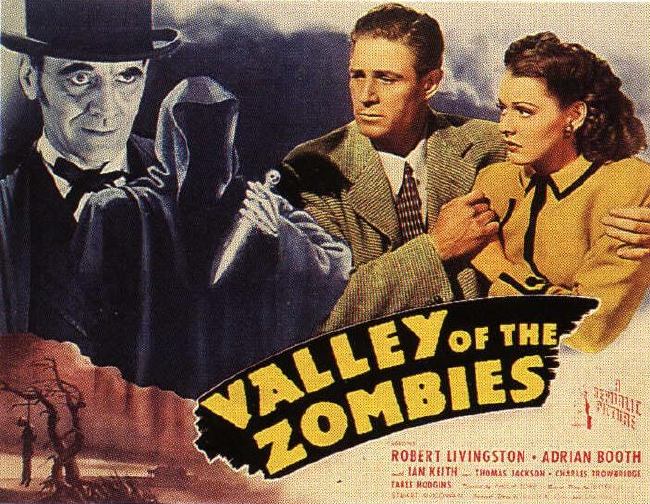
Nice poster, nice title but no valley and no zombies.  Not to mention no budget either.  I don’t have that much to say about this 56 minute quickie (as they used to call short movies back then) except that I wish the bad guy was played by Boris Karloff and not Robert Livingston.

The plot concerns Doctor Terry Evans (Livingston) killing people and using their blood to stay alive.  Most of the movie is just a police procedural with the film’s two main characters Fred (Earl Hogdins) and his wife/fiance Nurse Susan Drake (Lorna Gray) trying to prove their innocence after being in the scene of the crime.

If you must know the background, Dr. Maynard (Charles Trowbridge) wrongfully (or rightfully, I forgot which) diagnosed Evans as being insane and had him sent away to the looney bin, where he apparently died except that he didn’t and found some way of chemically sustaining his life.  Only he must constantly refill himself with blood and thus kills people to do so.

During most of the film the two protagonists do their own detective work Thin Man style since apparently the cops are too stupid to do it themselves.  They explore creepy houses and mausoleums while the guy leads the charge with total bravado and the girl, of course, acts frightened every time she turns her head.

But indeed, I was disappointed that the movie had no zombies.  I was hoping that Livingston would play a voodoo master.  He looks cool with his thick eyebrows, top hat and cape and he does hypnotize the leading female but, ultimately, there wasn’t enough going on even for a movie this short.  Now those RKO “sophisticated” low budget horror pictures like Cat People, The Body Snatcher and I Walked with a Zombie were good at “not showing” everything but this Republic picture ain’t like that.  It doesn’t show much and doesn’t have creepy atmosphere.  I still like some of the sets though.

Skinheads (1989)

Image

ImageImageImageImage

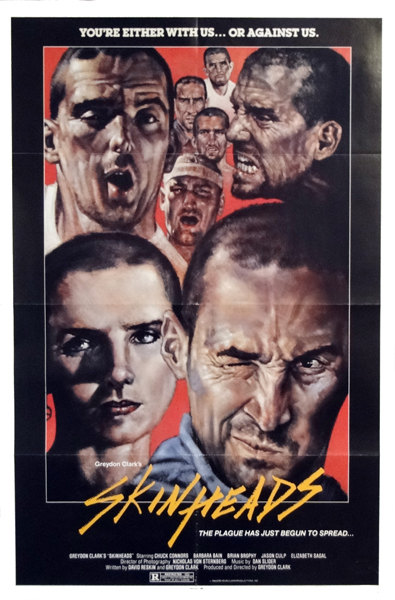
What great poster art!  I’m not kidding!  I don’t know who illustrated this, but it looks like the poster for a classic exploitation film, which Skinheads of course is!  Any of you SHARP, Trad or Trojan skins, who stumbled upon this post when doing a google search for “skinheads”, please know that I’m well aware of the original skinhead subculture from the 60s and 70s and that it was based upon music, not ideology, with their preferred style being reggae, ska and soul.

But, you know who didn’t do ANY research on skinheads?  Writer/director Greydon Clark, responsible for 1970s exploitation classics such as The Bad Bunch,  Black Shampoo and Satan’s Cheerleaders, is clearly NOT trying to make a social statement with this film, in spite the “serious” looking video box art, which got me interested in this movie in the first place!  This could easily have been a 60s/70s biker film, only that the nogoodniks in Skinheads actually believe in the swastikas they wear, rather than just using them as shocking regalia.  At least, as far as I know, none of the biker gangs from the 60s/70s believed in the Third Reich, but I could be mistaken.

I’m getting ahead of myself.  I don’t think Skinheads (a.k.a. Skinheads: The Second Coming of Hate) actually made it to theaters, which is a sad reflection of how home video killed the grind house and drive-in markets, nor has it been released on DVD.  I had to pull out the old VHS player to give this one a whirl.  And, BOY was it worth it!

The general story is that a group of neo-Nazi skinheads terrorize a small community in the San Francisco area.  After witnessing a fight, which leads to a shootout, the film’s protagonists escape into a secluded wooded area, and the skinheads go after them to try to kill them.  Never once do we see the cops because, I guess they were busy doing something else at the time.  Wait, no.  The skinheads cut a couple of phone lines, so nobody could call the cops and this is before everyone had a cell phone.

The group of skinheads consists of a crazy leader named Damon (Brian Bophy who I guess was in Star Trek: The Next Generation), an overweight, bumbling buffoon named Brains (the enormous Dennis Ott), a few lackeys and a skinhead girl named Liz (Lynna Hopwood), who is just as vicious as the guys.  They also inconspicuously drive around in a van with a swastika painted on the side.

The skinheads harass,fight and kill lots of people before the plot really takes off.  The main story involves the good guy Jeff (Jason Culp), the good girl Amy (Liz Segal of Howard the Duck and Double Trouble fame) and the old, all-American hero Mr. Huston (Chuck Connors from Airplane II and something else I forgot) defending their lives against the skinheads.

What’s there to say?  Skinheads is a whole heck of a lot of fun and really violent; a throat gets slashed, people get shot, someone gets cruficied and eaten by a bear, someone gets raped.  If you’re looking for a precursor to Romper Stomper or American History X, look elsewhere.  Skinheads is “straight from the headlines” exploitation and nothing more.  It’s so fun in fact, that my friend Josh wants to watch it practically every time we hang out.  We’ve watched it so many times, that we wore through the tape; which reminds me, I have to get myself another copy!

While most of the acting is pretty stock and intended just to get your through the plot, of which there are a few holes, as is par for the course, Chuck Connors and Brian Bophy own the show.  Spoiler alert: is it meant to be situational irony that the Connors character never finds out that his wife has been killed prior to the protagonists coming to his cabin?  Connors’ Heston-esque tough guy with a heart of gold is extremely hammy, yet it’s still touching hearing the WWII vet say, “there’s always another hate preaching bastard that needs to be stamped out!”.  Brian Bophy, on the other hand, makes Nick Cage look like he uses restraint.

The soundtrack was done by the Detroit based Elvis Hitler, which is interesting because Elvis Hitler is rockabilly band, yet the music they play in the movie sounds like Motorhead.  Oh, and if you’re an Easter egg hunter, check out the S.O.D. poster in the skinheads’ hideout.

Dust

Image
special introductory paragraph
Dust
Hard Attack

I’m assuming most of the intrigue for searching out Dust comes from Marc “Marky Ramone” Bell being in it years before he drummed for Wayne County and the Backstreet Boys, Richard Hell and the Voidoids and, of course, THE RAMONES!!!  The other two guys in Dust were guitarist/singer Richard Wise and bassist Kenny Aaronson, who also played a mean pedal steal guitar.  Wise later joined co-producer Kenny Kerner to produce Kiss and Aaronson became a session musician for a whole lot of people that I’m not going to mention.  Dust made two albums and that was it.

Dust – Kama Sutra – 1971

Image

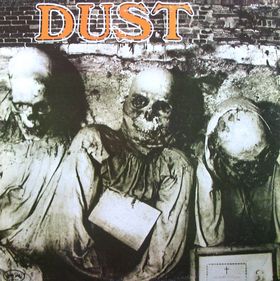
If you found the double LP reissue set containing the self titled Dust LP and their second album Hard Attack packaged together and on the plastic there was a sticker that read “the roots of American metal”, that is a lie, my friend!  Do not think for a second that the group Dust is an undiscovered, underground gem in the same vein as Pentagram and have a bunch of heavy, Sabbath doom riffs and horrific themes because you’ll be disappointed beyond belief.  Sure the cover looks scary but it’s a facade.

However, if you’re a fan of early, bluesy hard rock that is obviously influenced by Zeppelin and Grand Funk Railroad, then you’ve got yourself a nice pair o’ records to play!  The first Dust album contains seven original numbers that alternate between good-time groovy, kind of funky hard rock, acoustic pedal steal country blues, epic-length “Dazed and Confuses” blues rock trudgery and high speed – nay, damn near hardcore speed – boogie rock.

The album immediately blows apart the “American metal” myth with opening track “Stone Woman”, which rides along on an upbeat funky groove, complete with slide guitar.  One thing you may ask yourself when you hear this fun opening tune is, “how is that the same guy who drummmed in the Ramones?”  His snare dominated patterns and non 4/4 rockin’ make it clear that the music of the Ramones was way below his skill level.  Side two opener, “From a Dry Camel” is the aforementioned heavy, blues rock trudgery.  It’s similar to “Dazed and Confused” except the lyrics are really weird and it later picks up into a galloping beat.

So yeah, I don’t need to describe every song.  The lyrics are about typical rock subject matter; love, lust, roamin’ ladies and sucking water from a dry camels hump.  The guitars are beautifully loud and have various tones and Wise sings in the same high pitch 70s style as Mark Farner.  I mean, what’s there to say; this is proletarian hard rock to bang your head and/or fist to, so get to it man!

Hard Attack – Kama Sutra – 1972

hard_attack

Kind of looks like a Molly Hatchet album, doesn’t it?

Not only is the title for this album a stupid pun, it’s a complete lie!  Just like the sticker that says, “The Roots of American Metal”, this album is not only not metal, it’s not even hard rock!  The album begins with acoustic guitars and though the song “Pull Away/So Many Times” picks up the energy into an acoustic/electric gallop, it’s still not hard rock.  Furthermore the album proceeds to get lighter as we go along so that, by the time we’re on the third song, “Thusly Spoken”, we’re hearing an acoustic guitar/keyboard/piano/strings ballad!  “Hard Attack” my arse!

But, hey, here we go!  The fourth song, “Learning to Die” is a hella energetic hard rock song, who’s opening melody sounds like the Twilight Zone theme before proceeding into the main riff then a lighter, scarier part.  Then the eerie part goes away and we’re back into energetic rock ‘n’ roll zone!  Is this supposed to be social commentary?  “Every man learns to die/he has to leave his jewels behind”?  I dunno, whatever.  This song kind of reminds of Blue Oyster Cult with all them minor notes.

I already mentioned the group’s playing ability; guitarist Richard Wise and bassist Kenny Aaronson are perfectly fine on their instruments whether they’re playing electric/distorted or acoustic and, of course, Marc “Ramone” Bell is playing way more technically advanced stuff than he would in the Ramones.

What is with these existential lyrics, “somewhere somebody lives/somewhere somebody dies/but it was only time/somewhere somebody laughs/somewhere somebody cries/but it was only time”… what?  Good thing the song it comes from (“All in All”) has some neat start/stop boogie rockin’ with plenty of drum rolls and ultimately good time cheer and then, A COWBELL!!!  Did Marc Bell play a cowbell on the previous release?  Not that I recall… anyway…

Arrghh, now we’re back into acoustic zone with “I Been Thinkin’.”  In case you’re wonderin’ (ha!), I am reviewing the album in real time as the songs come.  I have listened to it a couple times before but I kind of enjoy this play by play approach.  Oh, hey… another hard rock song that starts off with some killer snare attack, some slides on the neck, then soloing, then three chord riff, then more soloing and it appears by the song’s set up, that “Ivory” will be an instrumental.  Some of these solos sound Toni Iommi-ish in parts.

Then one more acoustic, countryish ballad and one more, mean hard rocker with some honestly killer, angry riffs and more neato fills.  That’s the album for you.

Captain Kronos: Vampire Hunter (1974)

Image

ImageImage

It’s been a month or so since I’ve seen a Hammer horror film.  Unfortunately Captain Kronos: Vampire Hunter wasn’t the movie to bring me back into Hammer’s world.  There’s nothing particularly wrong with the film other than it’s just kind of dull.  The poster promises more than it delivers.  Don’t get me wrong; what you see in the poster is pretty much what happens in the movie but there just isn’t enough of it.

Apparently Brian Clemens’ only directorial effort was supposed to be the start of a series of Captain Kronos films and a story was later adapted into a comic book.  Maybe Hammer should have gotten a more seasoned director like Roy Ward Baker or Terence Fisher.  The movie goes against the typical vampire mythos by having them kill during the day rather than at night.  Also they don’t suck blood and create other vampires by doing so; they suck out the youth from young men and women and turn them old and dead.  The effect actually makes them look like Steven Tyler.

I guess my main problem with this movie is I kept wondering, “Where is Captain Kronos during all of this?  How is this alleged vampire hunter letting so many innocent souls get sucked away?”  Kronos is played by German actor Horst Jansen and is assisted by the hunchbacked doctor Dr. Marcus (John Carsen).  They traverse the countryside supposedly hunting vampires by burying toads in the ground and seeing if they’re alive or dead and if alive, oh who cares?

Kronos frees a cute little lady named Carla (Caroline Munroe) from a wooden rack but who is she?  What did she do?  The only background we are given about her character is that she was being punished for dancing on Sunday.  That’s it.  That’s her entire background.  I really hope Brian Clemens didn’t think, “well, she’s a woman!  What else do you need to know about her?”  Actually he might have been thinking that otherwise why else would her only purpose in the movie be to shack up with Kronos twice.  And she acts as vampire bate, whoopdy do!  I was about to blame Caroline Munroe for being so emotionless and useless but then I realized she didn’t write the character; she was just doing what the director told her to do!

The movie is heavily bogged down with useless subplot; three asshole swordsmen harass people at a local pub and, in one scene, the doctor expresses his gratitude for having such a great friend.  The doctor asks Kronos and Carla, “am I that ugly?”  Carla responds, “you have a kind soul, that’s what’s important.”  Uh, gee thanks…

There’s some blood and way neat looking castle set pieces so I enjoyed *looking* at stuff but as far as entertainment goes, I kept thinking, “can we please pick up the pace, here?”  And, to be perfectly honest, the actor who played Kronos wasn’t exactly a virtuoso either; he basically just held the same smart-ass, “ha! I kill vampires and sleep with hot women” expression the whole time.  So  you know, watch at your own risk, I guess.